
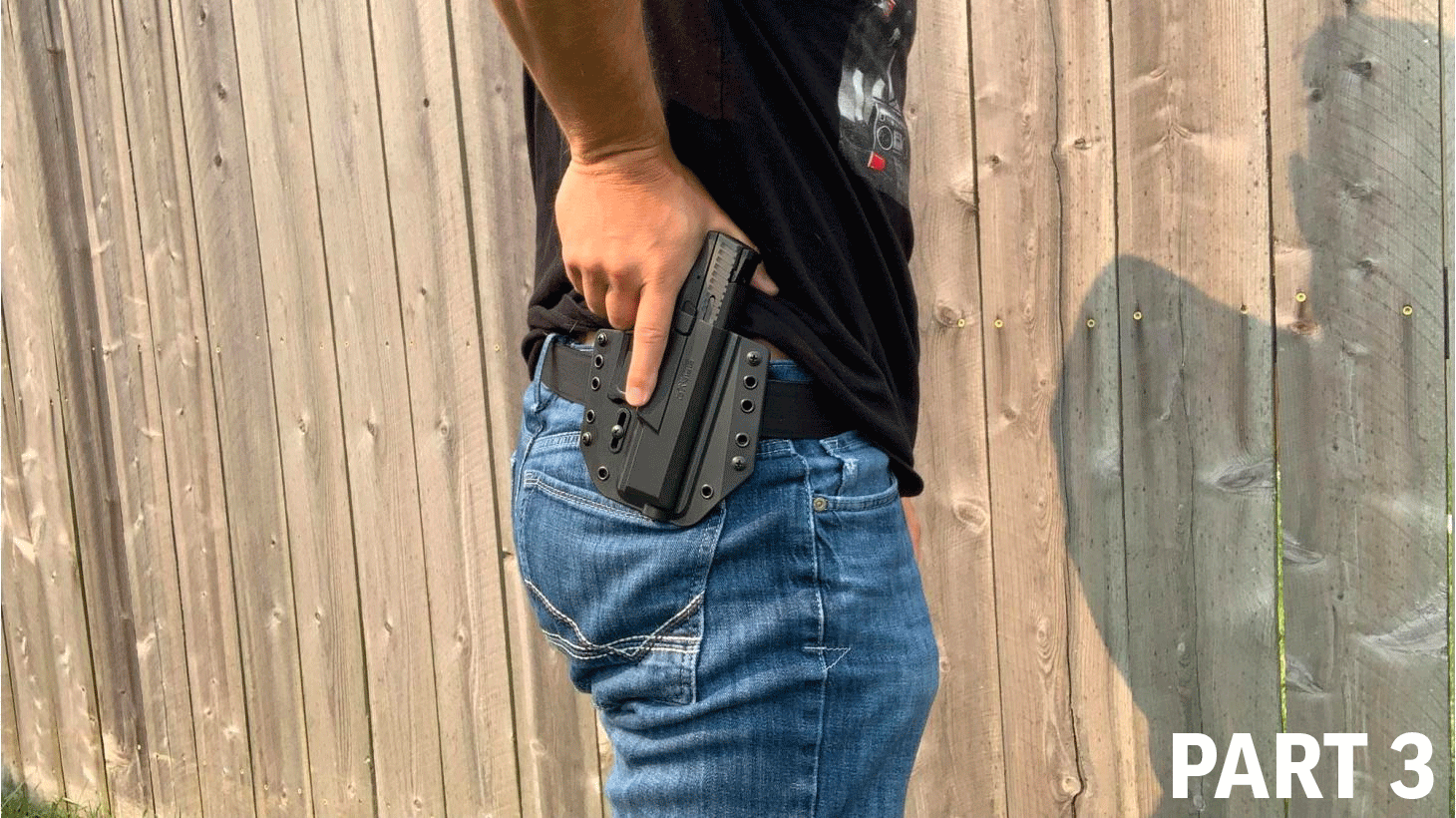
In a perfect world, we can thump our chests and say, “The Second Amendment IS my CCW Permit,” and we are in 100% agreement from an ideological perspective. Some jurisdictions require no proof of training or competency with a firearm before issuing a permit. Others require the most basic of credentials that may list the state statutes and how to clean a gun. Some have more stringent qualifications.
The bottom line is that shooting is a deteriorating skill, and if you do not train regularly, your draw will be slower, your shots less accurate, and your life and the lives of others can be put in jeopardy as a result.
You don’t need to be a steel-eyed Delta Force Commando Ninja Warrior to protect yourself, but you should know more than just the basics.
Remember: It is the basics performed well that will make you an expert.
Firearms Training
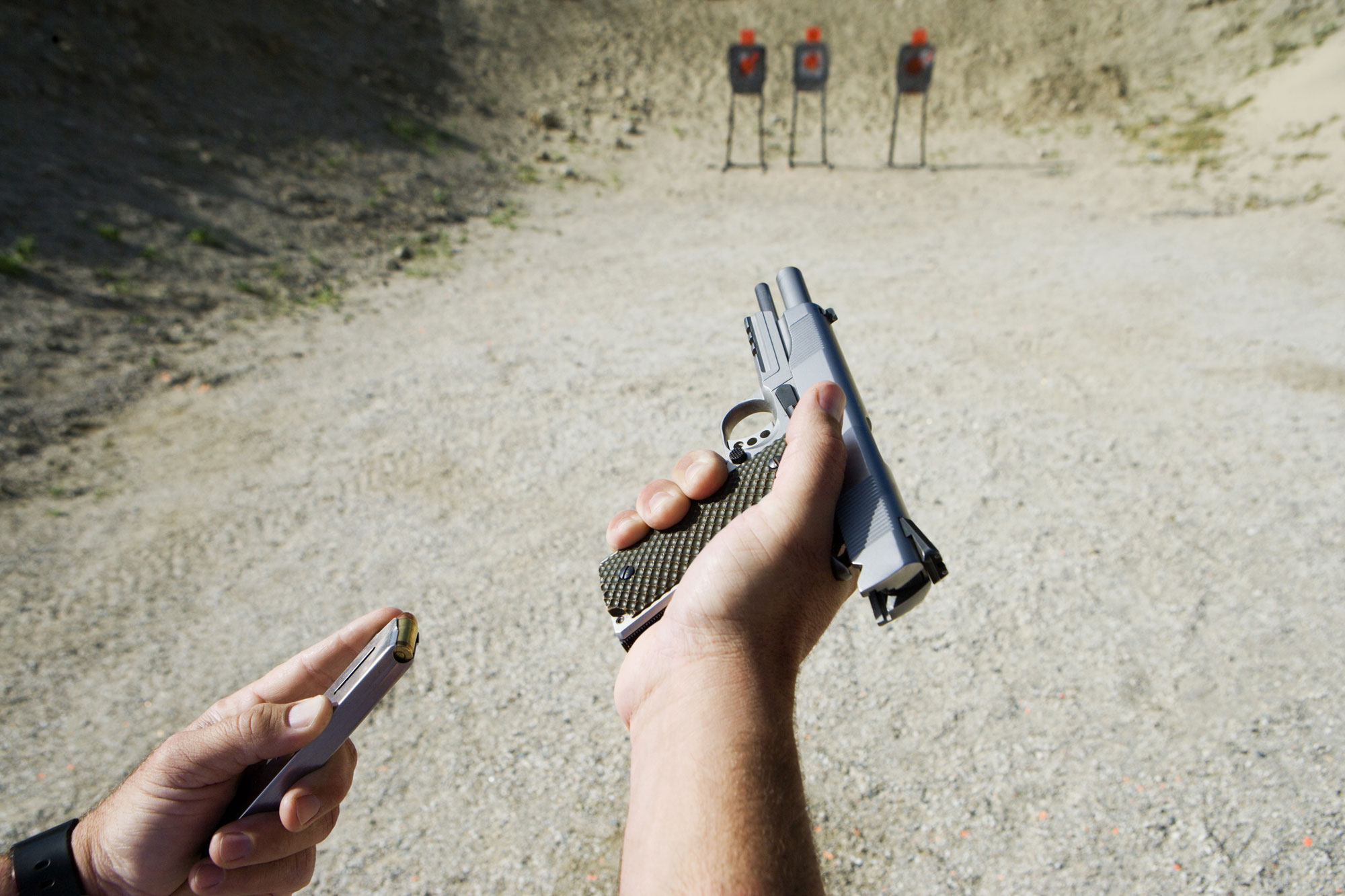
As always, the CCW holder should remember the two most important rules of gun safety:
“Treat all guns as if they are loaded.”
“Never point a gun at anything which you are not willing to destroy.”
Proper Shooting Mechanics
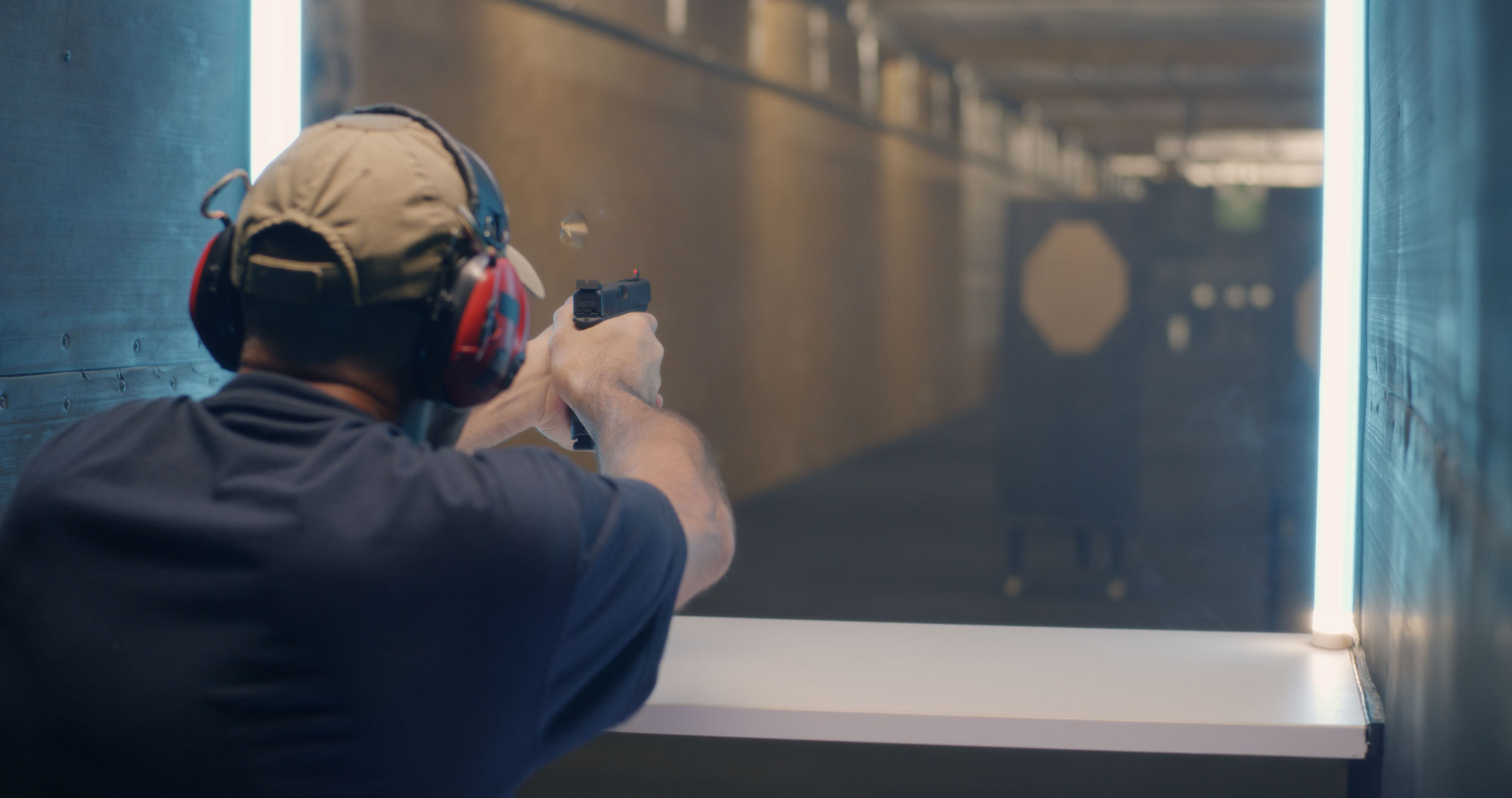
The first fundamental component of pistol shooting is acquiring a stance that provides a steady and repeatable platform. The feet should be shoulder-width apart, with the weight evenly distributed and parallel to the shoulders and hips. Keep your body at a 45-degree angle to the target.
The head should be held upright and pointed toward the target. The shooting hand should be fully extended and the non-shooting hand used for support. When gripping the pistol with the shooting hand, it should be firm, like a strong handshake. Muscle tremors will cause the pistol to shake or lead to tired hands if the grip is too tight and will affect accuracy. If the grip is too loose, the gun will move in the hand, and it could cause some semi-automatic pistols to malfunction.
The trigger finger should contact the trigger using only the pad of the finger, with the fingertip at a 90-degree angle to the front of the pistol. When held in the firing position, the pistol’s sights should be aligned so that the front sight is centered between the “ears” of the rear sight. The front sight should appear crisp and distinct, with the rear sight appearing slightly blurred; this is called “sight alignment.” When the sights are correctly aligned, they can be superimposed on the target, with the front sight dictating where the shooter wants to place the round. Like the rear sight, the target should appear blurry, focusing on the front sight. This is referred to as a “sight picture.”
Trigger Control & Discipline
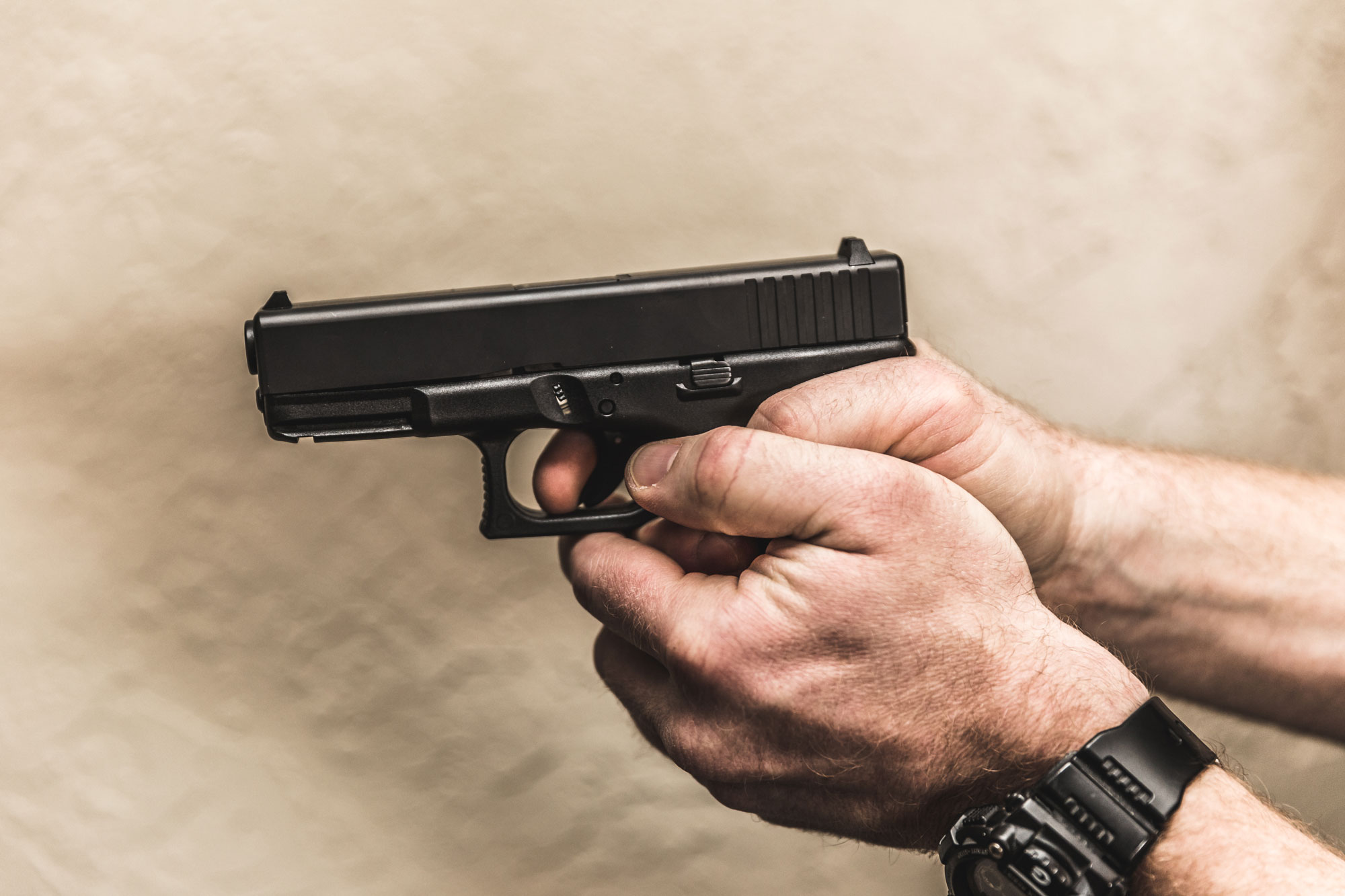
With the pad of the trigger finger, proper trigger pressure can be applied to the trigger. This is a three-step process consisting of slack, press, and follow-through.
The shooter must first take up the slack in the trigger by applying slight pressure. As the trigger moves to the rear, the internal components of the trigger group prepare the gun to fire. The shooter will feel the resistance of the trigger group disengaging to allow the hammer or striker to contact the firing pin and ignite the round. The trigger must be squeezed evenly with constant pressure through this entire process until the trigger has completed its rearward travel. If this pressure is not constant and consistent from beginning to end, the impact of the round may shift on the target.
Realistic Training
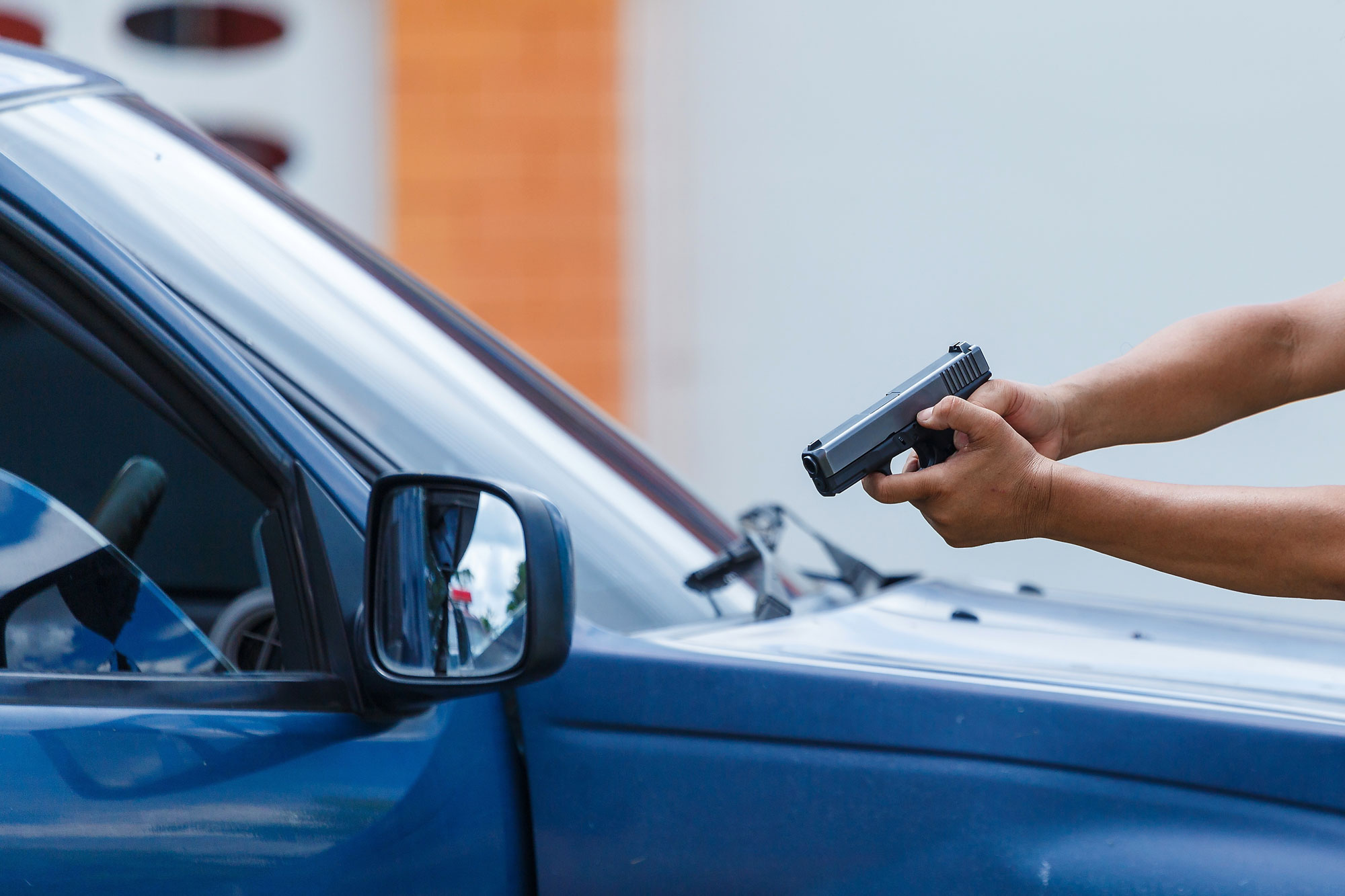
In combat, most people stop thinking with their forebrain, which controls higher cognitive functions, including concentration, reason, and abstract thought. Thinking is shifted to the midbrain, which operates on a more primal level to keep one alive during a fight. Unfortunately, there seems to be an ingrained resistance to killing members of the same species. This is seen in nature when animals compete in mating rituals that simulate combat. Rams and goats slam each other’s horns in an outwardly brutal but relatively harmless fashion. The male black mamba, one of the most aggressive and venomous snakes on earth, will fight other males in unique wrestling matches to pin each other’s heads to the ground, but against any other species, these snakes unleash their deadly fangs and venom without restraint. These are inherent survival mechanisms that prevent a species from destroying itself.
Brigadier General S. L. A. Marshall first observed this behavior among humans during the Pacific and European theaters of operations in World War II. Based on his post-combat interviews, Marshall concluded in his book Men Against Fire that only 15% of the individual riflemen in World War II fired their weapons at an exposed enemy soldier. Marshall wrote: “...from a civilization in which aggression, connected with the taking of life, is prohibited and unacceptable. The fear of aggression has been expressed so strongly and absorbed by him that it is part of the normal man’s emotional makeup. This is his great handicap when he enters combat. It stays his trigger finger even though he is hardly conscious that it is a restraint upon him”.
By 1946, the US Army had accepted Marshall’s conclusions and pioneered a revolution in combat training, which eventually replaced firing at round bulls-eye targets with human-shaped targets that fell when hit. By utilizing these realistic targets, shooting rates went up in combat to 40% during the Korean War and 95% during the Vietnam War.
The US Navy performed a study on fighter pilots in the 1960s that linked pilot survival rates and combat effectiveness to experience in the air. This led to the establishment of the TOPGUN program and combat flight simulators. It saved the US Government untold millions of dollars by having pilots practice air-to-air combat in simulated conditions so that the pilots would be ready when they went into battle.
While firing at paper targets from a dedicated firing line has its place in marksmanship training, it can lead to shooters’ dangerous behavior during a gunfight.
In the infamous 1970 Newhall Incident in California, four members of the California Highway Patrol were killed in a gun battle by two career criminals. In the aftermath of the shooting, training deficiencies were pointed out, including:
- The officers were armed with revolvers chambered in 357 Magnum; however, they had only practiced with the less-powerful 38 Special rounds in training without ever shooting the actual load they were issued for duty use.
- One of the officers had been unloading spent casings from his revolver into his hand and subsequently placed the empty brass into his shirt pocket.
- Several officers attempted reloads using loose ammunition by loading all six rounds at once while under fire.
The commonality to these incidents is that these were mistakes made in training that found their way into reality. This again goes back to “midbrain thinking.” The body is full of adrenaline, and the brain is thinking in survival mode. The cognitive ability to remember something read in a book or seen on a training video will not be there; the midbrain is going for the lowest common denominator by repeating an earlier action in a similar situation: training.
Realistic training should seek to simulate actual combat as close as possible while keeping the shooter as safe as possible. There is an adage among fighters: “Train like you fight so that you will fight like you train.”
- Follow the fundamentals of sight alignment, sight picture, trigger control, and body mechanics as much as possible while incorporating realistic scenarios into training.
- Practice one-handed shooting from either hand. This helps the shooter if the shooting hand or arm is injured or otherwise occupied or out of commission in a real-world defensive situation.
- If possible, shoot from behind cover and concealment. This prevents the shooter from standing up and becoming a target during a gun battle. Old pieces of furniture, discarded shipping pallets, and other make-shift devices can function as cover during a range session.
- In addition, to cover, the shooter should practice in-extremis shooting and reloading from various positions, including being seated, lying on the stomach, lying on the side, and lying on the back.
- Whenever possible, the shooter should practice drawing the weapon from a concealed holster.
As stated earlier, criminals attack when they perceive weakness. Shooters should practice carrying a bag of groceries and having to drop it while drawing and returning fire. A person may be attacked while performing roadside vehicle maintenance such as changing a tire; a drill can be performed while on the knees and drawing and firing on the threat.
Safe practices to keep in mind while training realistically should be to drop empty magazines, spent brass, or speed loaders to the ground. By the same token, shooters should wait until the end of any realistic training session to pick up empty cartridge cases.
Handgun Malfunction Drills
A firearm is a mechanical device. Even the best-made, the most reliable mechanical device can malfunction in less than ideal circumstances. The time to practice for these events is at the range, not in the middle of a gunfight. The two most common malfunction drills are failure to fire and failure to extract.
Failure to Fire
When the trigger is pressed, the handgun does not fire. This can be caused by failing to rack the slide when loading a magazine or a dud round. The malfunction drill follows this sequence:
- With the pistol aimed at the target, move the trigger finger from the trigger guard and tap the butt of the weapon to make sure the magazine is fully seated.
- Grasp the rear of the slide and pull it rearward. While doing this, turn the gun to the right so that the ejection port is facing down. Release the slide and let it move forward under its momentum.
- Return the pistol to the proper position, aim at the target, and squeeze the trigger to fire.
This can be simulated in training by entirely unloading the weapon and inserting a fresh magazine with the slide forward.
Failure to Eject

When the trigger is pressed, the handgun does not fire, but the trigger has a strange feel because an empty case either failed to eject or is stuck in the ejection port with the slide closed on it. The malfunction drill follows this sequence:
- With the handgun aimed at the target, move the trigger finger from the trigger guard and tap the butt of the weapon to make sure the magazine is fully seated.
- Grasp the rear of the slide and pull it rearward. While doing this, turn the gun to the right so that the ejection port is facing down. Release the slide and let it move forward under its momentum.
- Return the pistol to the proper position, aim at the target, and squeeze the trigger to fire.
This can be simulated in training by entirely unloading the weapon and inserting an empty case into the ejection port with the slide rearward. The shooter should close the slide on the case and insert a fresh magazine.
Other Ways to Practice
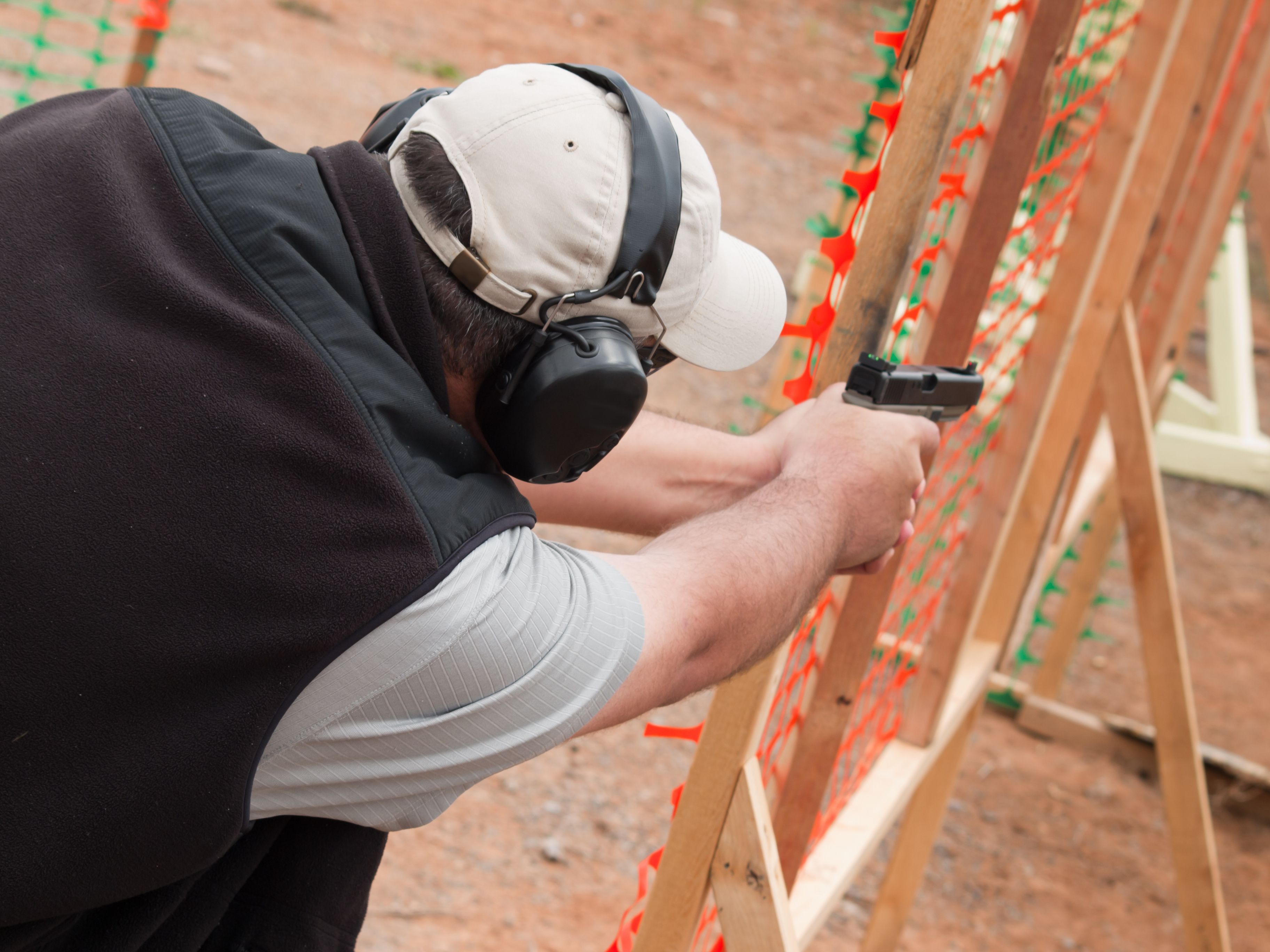
fAfter a CCW holder has become an adequate shooter, other venues put their shooting and gun handling skills to the test. Several different shooting sports emphasize realistic training to one degree or another. Some of the most common which involve shooting while moving, making use of cover, and reactive targets are IPSC (International Practical Shooting Confederation), USPSA (the United States Practical Shooting Association), and IDPA (International Defensive Pistol Association). Some of these organizations use random scenarios as specified earlier in this section as part of a match, with the details not revealed until an hour before the match begins.
In Conclusion
Carrying a concealed weapon is more than the act of applying for a permit, purchasing a handgun, and going forth in the world. The CCW holder must be educated on the rules of deadly force, marksmanship, and the laws of any jurisdictions where they decide to carry. A CCW holder must practice with their weapon from various shooting positions and break any bad shooting habits. Furthermore, a CCW holder must be aware of their surroundings and know when it is appropriate to ratchet up or down their awareness level.
In case you missed it, Conceal Carry Basics: Part 1 covers CCW firearms, ammo, carrying techniques, etc., and Conceal Carry Basics: Part 2 covers situational awareness and mental preparation.
South Carolina and North Carolina residents, get your Concealed Carry Permit at a Palmetto State Armory location near you.